Joint ESA-JRC-UNODC workshop addresses fast growing environmental crime
1 October 2026 - Frascati, Italy
The ESA-JRC-UNODC joint Environmental Crimes 2026 workshop held in Frascati, Italy (29 September - 01 October 2026) was aimed at addressing environmental crime which “remains one of the fastest-growing forms of organised crime worldwide, with estimated annual growth rates of 5–7%. It is highly complex to detect, investigate and prosecute, as criminal networks often operate across borders and exploit differences in legal frameworks, enforcement capacities and national priorities”. [1]
According to the ESA website “Addressing these crimes requires strong international cooperation, both to dismantle transnational criminal networks and to support more harmonised, effective enforcement. … Robust evidence and high-quality documentation are essential to detect, investigate and prosecute environmental offences. In this context, new technologies and analytical tools can play a decisive role. Recent advances in Earth Observation (EO), particularly satellite-based monitoring, have made it possible to access data with increasing spatial, spectral and temporal detail. EO-based intelligence can significantly enhance environmental crime investigations by strengthening monitoring, inspection and evidentiary capabilities. At the same time, its operational and legal use raises important challenges, including data access and quality, privacy considerations, cross-border data sharing, and the admissibility of geospatial evidence in judicial proceedings.” [1]
Key among the objectives of this year’s workshop was the need for “Aligning with stakeholders’ agenda, highlight the importance of developing crime-countering strategies that are evidence-based and data-driven, addressing both the root causes of crime and its environmental, societal and economic dimensions.” … and to “Outline a way forward to implement new solutions for a wider uptake of EO into investigations of environmental crimes”. [1]
IES President Wouter Veening speaks on Leveraging Earth Observation for Prevention, Enforcement and Accountability
In the presentation by IES president Wouter Veening at the workshop on 1 October he explored how Earth Observation and geospatial intelligence can strengthen decision-making, support investigative and enforcement activities, and improve accountability for environmental harm.
Environmental crime increasingly intersects with organised crime, illicit financial flows, smuggling, conflict and serious violations of international law. Addressing these interconnected threats requires moving beyond environmental monitoring towards integrated environmental security approaches that combine scientific evidence, governance, law enforcement and international cooperation.
Drawing on the experience of the Institute for Environmental Security, he highlighted the use of satellite data and complementary information sources to detect and document environmental degradation, identify patterns linked to criminal activities, support investigations into money laundering and illicit trafficking, and contribute to the assessment of potential ecocide and crimes against humanity.
"Environmental crime increasingly intersects with organised crime, illicit financial flows, smuggling, conflict and serious violations of international law"
The presentation also addressed the institutional and operational conditions required to transform geospatial information into actionable knowledge, including data integration, capacity building, legal frameworks, cross-sector cooperation and access to scientifically robust decision-support tools.
Particular attention was given to bridging the gap between environmental policy and security policy, enabling authorities and international organisations to respond more effectively to complex and transnational environmental threats. [2]
>>> Download the presentation >>>
233 Arrested in Environmental Crime Crackdown in Latin America and Caribbean
In a related story [3] published on the INTERPOL website on 7 October 2026, it was reported that “An international operation coordinated by INTERPOL has dismantled environmental crime networks across nine countries in Latin America and the Caribbean, leading to 233 arrests, the recovery of more than 1,000 animals and the identification of 60,000 hectares of illegally cleared forest”.
Krandall Gullock, Head of the INTERPOL Regional Bureau for Central America said: “Across Latin America and the Caribbean, investigators are tracing payments and identifying the companies and properties used to hide criminal activity across borders. By linking those findings across jurisdictions, they gain a clearer picture of how these networks operate, how far they stretch and who exactly is involved”.
Amazon deforestation probe uncovers global corporate links
According to the article “One of the clearest examples of this approach emerged from the 2025 Madre Tierra Operation, when Colombian authorities requested INTERPOL support in an investigation into 11 foreign companies identified as suspects of industrial-scale deforestation. The network was suspected of clearing more than 52,000 hectares of protected forest in the Amazon basin, equivalent to approximately 73,000 football fields.”
The article also reports on raids targeting illegal mines and wildlife trafficking routes in Costa Rica and Nicaragua. Thomas Ungerbuehler, INTERPOL Assistant Director of Environmental Security is quoted as saying: “These cases demonstrate the transnational nature of environmental crime, with biodiversity-rich countries increasingly targeted as sources of high-value commodities destined for illicit markets around the world. They highlight the importance of sustained international cooperation to identify, disrupt and dismantle the criminal networks driving this trade and threatening global biodiversity.”
[1] Environmental Crimes 2026 Workshop, Background https://envcrimes2026.esa.int/#programme
[2] Environmental Crimes 2026 Workshop, Programme, Session 8 - Global operational and end-user perspectives https://envcrimes2026.esa.int/agenda/
[3] “ 233 arrested in environmental crime crackdown in Latin America and Caribbean” https://www.interpol.int/en/News-and-Events/News/2026/233-arrested-in-environmental-crime-crackdown-in-Latin-America-and-Caribbean?shem=aimgspe
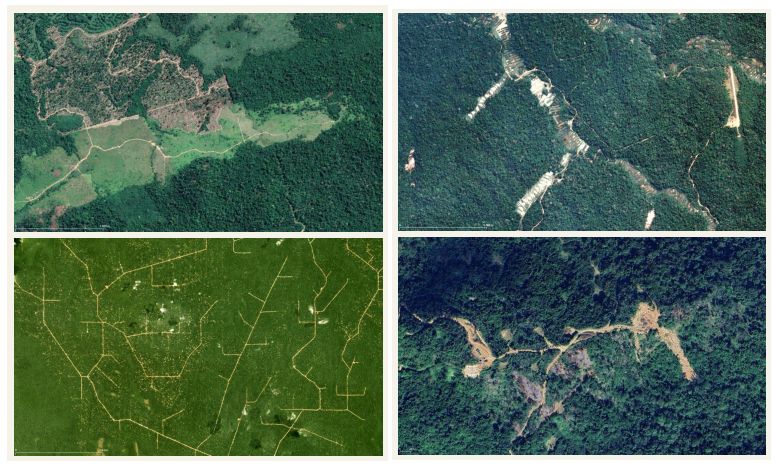
Cover image: Forest disturbance takes different forms. In its work to protect forest ecosystems around the world, the IES has a long-term working relationship with the remote sensing company GAF, in Munich, Germany. Source: GAF AG, forest canopy disturbance / ASM monitoring examples, 2026. 09