The Rome Statute & The Kakhovka Dam: Prospects of International Criminal Law
Political ecologist Wouter Justus Veening, President of the Institute for Environmental Security, was a lecturer in the training programme for the Office of the Prosecutor General of Ukraine in Kyiv dealing with Specific Features of War Crimes Against the Environment on 29 May 2026.
In his talk entitled “The Rome Statute & The Kakhovka Dam: Prospects of International Criminal Law” Veening outlined the critical intersection of international criminal law and war crimes against the environment, focusing on the Nova Kakhovka dam breach in Ukraine.
About the Dam Breach
The dam was breached in the early hours of 6 June 2023. The explosion targeted the Kakhovka Hydroelectric Power Plant, which was holding back a massive reservoir containing 18 cubic kilometers of water.[1]
Multiple independent experts, engineering analysts, and international monitors concluded that Russian military forces were responsible. The dam had been under strict Russian military occupation since the initial days of the 2022 invasion. [2] The Ukrainian government specifically blamed Russia's 205th Separate Guards Motor Rifle Brigade for rigging the internal structure with explosives to disrupt a planned Ukrainian counter-offensive.[3] Russian authorities denied the accusations, alternatively claiming the collapse was caused by Ukrainian shelling or pre-existing structural neglect.[4]
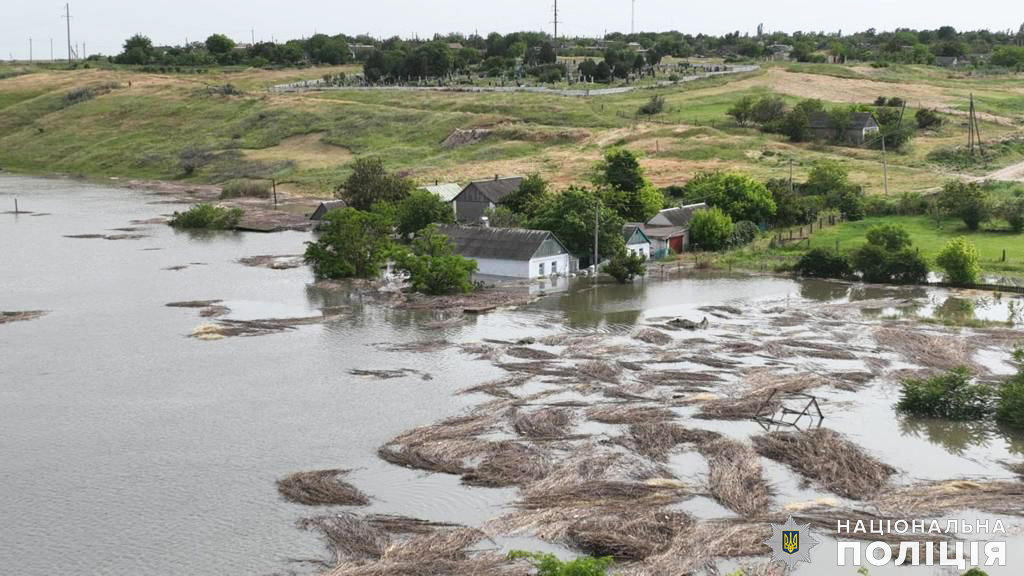
The breach released a torrent of high-velocity water that flooded roughly 600 square kilometers of land, completely inundating over 30 downstream settlements and the city of Kherson. More than 40,000 people lived in the immediate risk zones, forcing tens of thousands to evacuate under fire.[5] The dam, one of the largest in Europe, served as a vital source of drinking water for at least 700,000 people.[6] According to the New York Times, quoting President Volodymyr Zelensky, “hundreds of thousands of people have been left without normal access to drinking water.” [7] and the EU Civil Protection and Humanitarian Aid agency reported that “Entire towns lost electricity, and vital civic networks were destroyed” [8]
Severe Agricultural Damage: The disaster abruptly cut water supplies to vital canal networks, rendering 94% of irrigation systems in the Kherson region useless.[9] In all the flooding and subsequent drought conditions destroyed millions of tonnes of essential grain, oilseed, and vegetable crops.[10]
Long-Term Ecological Ruin: Dropping reservoir water levels resulted in massive die-offs of aquatic life, leaving millions of dead fish stranded on the dry reservoir bed.[11] Toxic Contamination: The floodwaters washed through industrial sites, releasing hundreds of tonnes of machine oil, petroleum products, and chemical fertilizers into the Dnipro River ecosystem.[12]
Prospects of International Criminal Law
In his presentation Veening stated that environmental disruption is framed alongside planetary risks, noting that global greenhouse gas emissions tied to the Russian aggression and Ukraine's defense from 2022 to early 2026 reached an estimated 236.8 million tonnes of CO₂ equivalent, causing approximately $57 billion in environmental damage.
He added that massive climate and environmental damage are increasingly classified under the doctrine of "ecocide".
Legal Frameworks & Prosecution Challenges
In referring to the Rome Statue Invocations, in his presentation, Veening said that legal accountability hinges on Article 8(2)(b)(iv) of the Rome Statute, which prohibits launching intentional attacks known to cause "widespread, long-term and severe damage to the non-human environment" and that to build a successful case before the International Criminal Court (ICC), investigators must prove the environmental devastation was clearly excessive compared to any anticipated direct military advantage. Prosecution requires identifying explicit individual decisions and military command hierarchies—stretching up to high-level Russian leadership—rather than relying on abstract state-level blame.
Data-Driven Tools for Justice
To meet strict ICC evidentiary standards, organizations like the Conflict and Environment Observatory (CEOBS) launched WISEN (The Wartime Incidents to Environment Database). This database combines satellite imagery, field-based testimony, and footage to calculate localized environmental harm scores. High-scoring incidents are compiled into comprehensive legal dossiers to support accountability .
Conclusion
Veening concluded that while frameworks like Article 8(2)(b)(iv) are vital, international courts must expand and strengthen their capacities to successfully prosecute future ecocide crimes.
>>> Download the PDF version of the Presentation >>>
Photo: Flood in Mykolaiv Oblast after the destruction of the Kakhovka Dam. Barativka village (Horokhivske rural hromada) on Inhulets River. From the National Police of Ukraine. Licensed under the Creative Commons Attribution 4.0 International license https://commons.wikimedia.org/wiki/File:Flood_in_Mykolaiv_Oblast,_2023-06-08_(1).jpg
.jpg)
References:
[1] Mara Tignino, Tadesse Kebebew, Caroline Pellaton, “International Law and Accountability for the Nova Kakhovka Dam Disaster” Lieber Instiute – West Point, Jul 13, 2023. https://lieber.westpoint.edu/international-law-accountability-nova-kakhovka-dam-disaster/
[2] “Destruction of the Kakhovka Dam”, Wikipedia, Text last updated 22 May 2026, at 22:51 (UTC). Citing Glanz, James; Santora, Marc; Pérez-Peña, Richard (6 June 2023). "Internal blast probably breached Ukraine dam, experts say (cautiously)". The New York Times. ISSN 0362-4331. Text is available under the Creative Commons Attribution-ShareAlike 4.0 License. https://en.wikipedia.org/wiki/Destruction_of_the_Kakhovka_Dam
[3] Ibid.
[4] Sabbagh, Dan; Borger, Julian (6 June 2023). "Thousands flee homes as collapse of dam is blamed on Russian forces". The Guardian. Archived from the original on 6 June 2023. Retrieved 6 June 2023. Guardian. ISSN 0261-3077. Archived from the original on 6 June 2023. Retrieved 6 June 2023. https://www.theguardian.com/world/2023/jun/06/ukraine-accuses-russia-of-blowing-up-nova-kakhovka-dam-near-kherson
[5] Hanna-Kaisa Lepik, ”A disaster in photos: Nova Kakhovka dam breach in Ukraine”, EU Civil Protection and Humanitarian Aid, European Commission https://civil-protection-humanitarian-aid.ec.europa.eu/news-stories/stories/disaster-photos-nova-kakhovka-dam-breach-ukraine_en
[6] Mara Tignino, Tadesse Kebebew, Caroline Pellaton, “International Law and Accountability for the Nova Kakhovka Dam Disaster”, Lieber Institute West Point, Jul 13, 2023, https://lieber.westpoint.edu/international-law-accountability-nova-kakhovka-dam-disaster/, in citing rw Response, Humanitarian Bulletin, Various Pages. https://response.reliefweb.int/results?q=Kakhovka+Dam
[7] Matthew Mpoke Bigg, “Ukraine Dam Disaster: What We Know”, New York Times, June 6, 2023, Updated June 7, 2023 https://www.nytimes.com/2023/06/06/world/europe/ukraine-dam-explainer.html
[8] Hanna-Kaisa Lepik, ”A disaster in photos: Nova Kakhovka dam breach in Ukraine”
[9] “More than 1,100 km of irrigation canals left without water in Ukraine”, Ukrinform, 12 June 2026 as reported by the press service of the State Agency of Land Reclamation and Fisheries of Ukraine. https://www.ukrinform.net/rubric-economy/3720731-more-than-1100-km-of-irrigation-canals-left-without-water-in-ukraine.html
[10] Simeon Djankov, “The cost of the Kakhovka Dam destruction” VOX EU / DEPR, 10 Jul 2023, https://cepr.org/voxeu/columns/cost-kakhovka-dam-destruction
[11] Novitskyi, Roman; Hapich, Hennadii; Maksymenko, Maksym; Kovalenko, Volodymyr, “Loss of fisheries from destruction of the Kakhovka reservoir” International Journal of Environmental Studies, Volume 81, Issue 1, pp. 315-323, 9 pp. Abstract. https://ui.adsabs.harvard.edu/abs/2024IJEnS..81..315N/abstract
[12] O. Shumilova, et al. “Environmental effects of the Kakhovka Dam destruction by warfare in Ukraine”, Science, 13 Mar 2025, Vol 387, Issue 6739, pp. 1181-1186 https://www.science.org/doi/10.1126/science.adn8655